
What Is an eSIM Reseller? A Practical Guide
eSIM stores & resellers
2SkyMobile Team
Nov 11, 2026
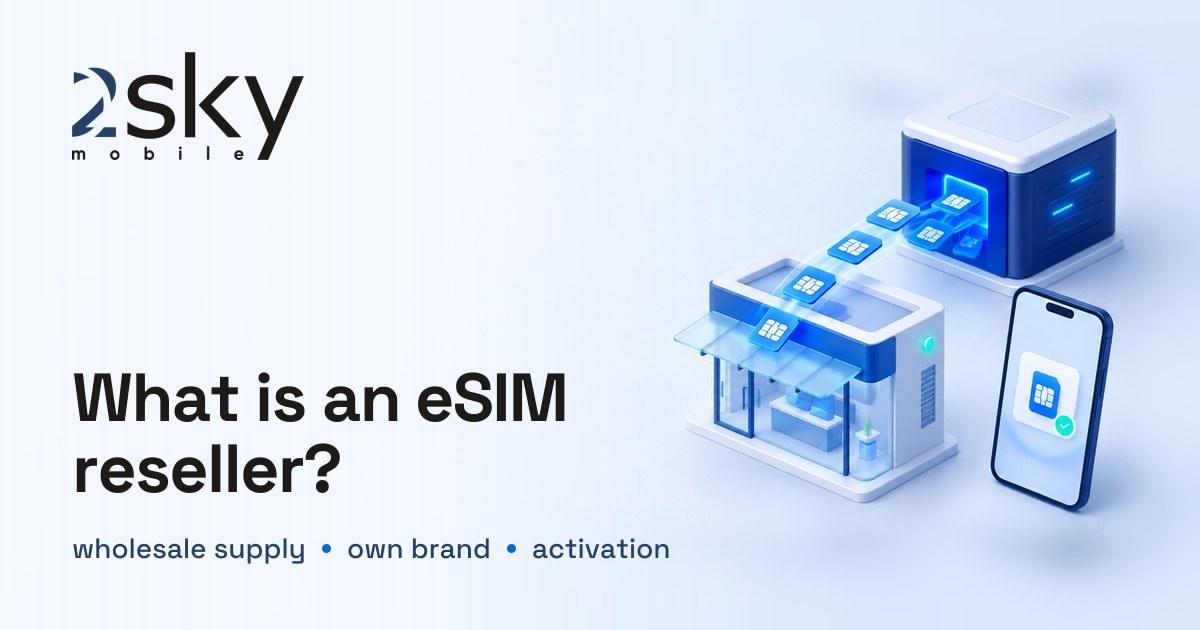
An eSIM reseller buys wholesale connectivity and sells plans under its own brand. See how the role differs from a wholesaler and an end user.
An eSIM reseller buys wholesale connectivity, applies its own brand, pricing and customer experience, and sells eSIM plans to end users. The role matters most to founders and product leads at travel apps, fintechs and digital brands that want to sell connectivity without becoming an operator. The reseller owns the offer and the customer relationship. It does not own the network.
Where the reseller sits in the connectivity chain
Connectivity passes through four layers. Licensed operators run the networks. Wholesale providers package access to those networks for business customers. Resellers turn that access into a product people can buy. End users install and use it.
The reseller's work is commercial and product work. It decides which plans to feature, sets the price, designs the purchase flow, writes the help content and carries the brand. The wholesale layer supplies the connectivity.
When you already have an audience and a checkout, reselling fits well. You add a product to an existing relationship instead of building a new one from scratch.
Reseller, wholesaler and end user compared
The three roles differ by who they buy from, who they sell to and who holds the customer relationship.
| Role | Buys from | Sells to | Customer relationship |
|---|---|---|---|
| Wholesaler | Licensed network operators and partners | Businesses: resellers, MVNOs, aggregators | Business-to-business |
| Reseller | A wholesale provider | End users, under its own brand | Direct, with its own pricing and support |
| End user | The reseller | Nobody; uses the plan | Customer of the reseller |
The boundaries can blur. An MVNO buys wholesale and sells to consumers, so it also acts as a reseller of connectivity. A reseller that starts selling to other businesses begins to look like an aggregator or wholesaler.
Use one test. Ask who the paying customer is and who answers their questions. If end users pay you and contact you under your brand, you are the reseller.
What the reseller controls and what it relies on
A reseller controls the parts of the product that customers see:
- Brand and storefront design
- Pricing and plan packaging
- Purchase flow and checkout
- Customer communication and first-line support
- Which plans and destinations to feature, within the supply available
A reseller relies on others for the parts customers cannot see:
- Network coverage and quality, which come from licensed operators
- Supply terms and plan structure, which come from the wholesale provider
- The provisioning platform that delivers the eSIM
- Regulatory conditions, which vary by market and by agreement
The trade-off is direct. More control over the experience means more responsibility for it. When a customer cannot connect, they contact your brand, not the operator. Choose a supplier whose terms you can explain to your own customers in plain language.
2SkyMobile operates B2B and wholesale, and it does not sell consumer retail plans. Connectivity is delivered through licensed third-party operators.
Who resells eSIM and why
Typical resellers are travel apps, fintech platforms, online travel agencies, IoT platforms and MVNOs. Each has a different reason to sell connectivity.
- Travel apps and online travel agencies. They already meet the traveller at the point of planning or booking. Connectivity fits that moment, so it works as an add-on to the main purchase.
- Fintech platforms. They already hold an engaged user base inside an app. Connectivity can serve as an extra product or a feature of a wider proposition.
- IoT platforms. They manage devices and need connectivity to go with them. Reselling lets them offer data as part of the platform instead of sending customers elsewhere.
- MVNOs. They buy wholesale data to extend their portfolio, for example with eSIM plans aimed at a specific segment.
The common factor is an existing customer relationship. Reselling pays off when you already have somewhere to put the product and someone to sell it to. It pays off less when you would have to build the audience first.
Choosing a reseller model
You can resell in more than one way. Match the model to what you already have.
When you want a store live without building the purchase flow, choose a white-label storefront. See white-label eSIM store.
When you have your own app and checkout, integrate wholesale supply into your product. The cost is more product and engineering work on your side. See wholesale mobile data. Integration options and scope are by agreement.
When you want to sell to other businesses, plan for a wholesaler or aggregator role. You then take on supplier-side obligations, such as terms, onboarding and support for business customers. That is a different business from selling to end users, so decide it deliberately.
Start with the model that needs the least new infrastructure on your side. You can move to a deeper integration once you know how customers buy.
What to check before you launch
Check these points before you sell your first plan.
- Supply terms. Confirm which destinations and plan structures are available, and on what conditions. Terms vary by partner agreement, so get them in writing.
- Support split. Define who handles first-line questions, who handles escalations and how each is reached.
- Customer experience. Decide how you will explain device compatibility, installation and activation. Customers need an eSIM-capable device and clear steps.
- Brand and checkout control. Confirm what you can customise and what stays fixed in the storefront or integration.
- Regulatory and payment obligations. These depend on the markets you sell in and on your agreement. Review them with qualified advisers before you launch.
- Your own pricing logic. You set the price. Decide how you will package plans before you configure anything.
An eSIM reseller succeeds on product and support, not on network ownership. The eSIM reseller program page shows the three ways to start with 2SkyMobile. If you want to test this model against your own app or platform, you can start a conversation with the team at 2SkyMobile.
Key facts
- models
- A reseller can launch through a white-label storefront or integrate wholesale supply into its own app or platform.
- definition
- An eSIM reseller buys wholesale connectivity, applies its own brand, pricing and customer experience, and sells eSIM plans to end users.
- 2skymobile role
- 2SkyMobile works B2B and wholesale, does not sell consumer retail plans, and delivers connectivity through licensed third-party operators.
- typical resellers
- Typical resellers are travel apps, fintech platforms, online travel agencies, IoT platforms and MVNOs.
- versus wholesaler
- A wholesaler supplies connectivity to business customers, while a reseller sells to end users under its own brand.
- reseller responsibility
- The reseller owns the customer relationship and first-line support, but not the network.
FAQ
- What is an eSIM reseller?
- An eSIM reseller buys wholesale connectivity, applies its own brand, pricing and customer experience, and sells eSIM plans to end users. It owns the customer relationship but not the network.
- What is the difference between an eSIM reseller and a wholesaler?
- A wholesaler supplies connectivity to business customers such as resellers, MVNOs and aggregators. A reseller buys that supply and sells plans to end users under its own brand.
- Does an eSIM reseller need its own network?
- No. A reseller relies on a wholesale provider, and connectivity is delivered through licensed operators. Regulatory conditions vary by market and agreement, so check them before you launch.
- Who typically becomes an eSIM reseller?
- Typical resellers are travel apps, fintech platforms, online travel agencies, IoT platforms and MVNOs. They share an existing customer relationship where connectivity fits.
- Does 2SkyMobile sell eSIM plans to consumers?
- No. 2SkyMobile works B2B and wholesale and does not sell consumer retail plans. Resellers sell to end users under their own brand.