
How a White-Label eSIM Store Works
eSIM stores & resellers
2SkyMobile Team
Nov 11, 2026
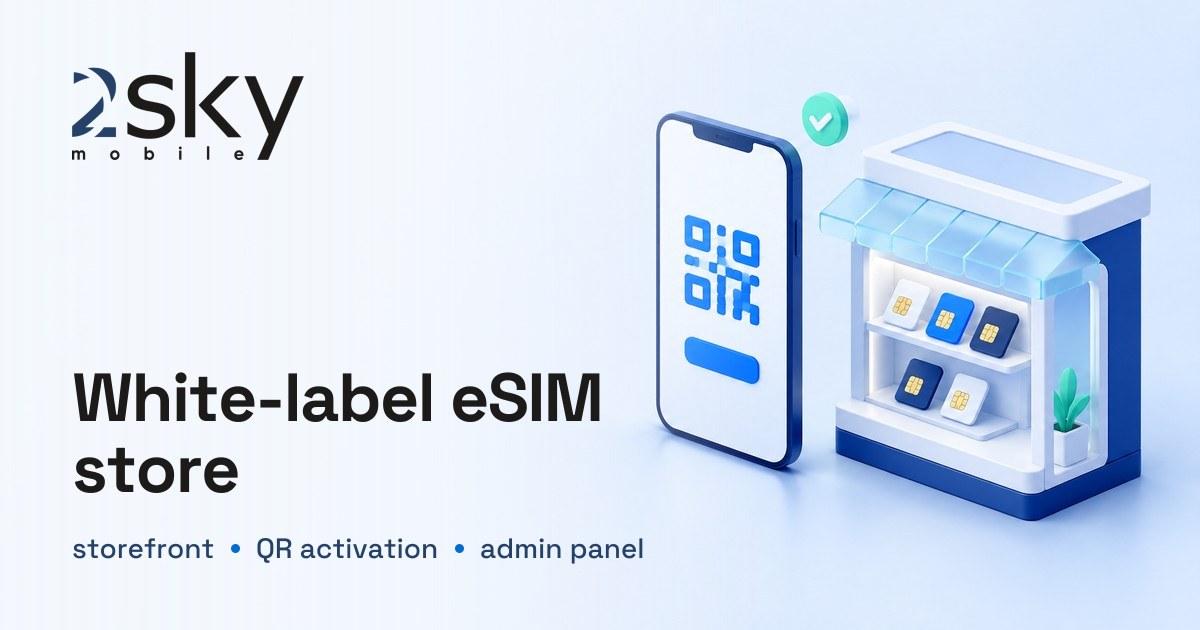
Learn what a branded eSIM store includes, how storefront, app, admin panel and QR activation fit together, and what a reseller must prepare.
A white-label eSIM store is a branded sales channel built from four parts: a storefront where customers buy, a mobile app for customers, an admin panel where you run the business, and QR activation that delivers the eSIM to the device. It matters to resellers and digital brands that want to sell connectivity under their own name without building commerce software from scratch. 2SkyMobile offers a White-Label eSIM Store made of a branded store, an app and an admin panel. Its eSIM Store development track covers web, mobile app and QR activation.
The four parts of a branded eSIM store
Each part has a different user and a different job. Weakness in one shows up in the others.
| Part | Main user | Job |
|---|---|---|
| Storefront | End customer | Browse plans, check out, receive the eSIM |
| Mobile app | End customer | Use the branded app |
| Admin panel | Reseller team | Run the store |
| QR activation | End customer and device | Deliver the eSIM profile to the phone |
The customer sees three of the four parts. You work in the fourth. Plan all four together, because a decision in the admin panel, such as how you name a plan, appears in the storefront, in the app and in support conversations.
Storefront: where the customer buys
The storefront is the web sales surface. It carries your brand, your plan catalog and your checkout. Buyers may arrive from search, partner pages or campaigns.
Three things matter more than visual polish:
- Plan clarity. A buyer must see coverage, data allowance and validity before paying. When plans are hard to compare, the support queue absorbs the confusion.
- Device compatibility. An eSIM only works on a compatible, unlocked device. State this on the product page and again at checkout. A customer who buys for an incompatible phone becomes a refund request.
- Delivery after payment. The customer should leave checkout knowing exactly how the eSIM will arrive and what to do next.
When your audience is mostly travellers buying on a phone, design the storefront for mobile browsers first. When you sell to businesses, add the information a buyer needs for internal approval, such as clear terms and invoicing details. The platform supplies the structure. The content is your responsibility.
App and QR activation: how the customer gets connected
The app and QR activation cover the part of the journey after payment.
QR activation works like this. After purchase, the customer receives a QR code. They scan it with the phone, and the device installs the eSIM profile. The customer then switches the line on, and data runs over the network of the licensed operator behind the plan. The customer does not need a physical SIM or a store visit.
The app adds a durable place for the customer to return to.
When you choose between web-only and web plus app, use this rule:
- Choose web plus app when you expect repeat purchases, top-ups or customers who want to manage several eSIMs.
- Choose web-first when sales are one-off and the customer wants the eSIM installed quickly. Add the app when repeat behaviour justifies it.
The QR step can also prompt support questions. Write a short, plain installation guide in your own voice, and place it where the customer will see it right after purchase. Cover the common cases: installing on arrival or before travel, and what to do if the code was already scanned.
Admin panel: where the reseller runs the business
The admin panel is the part the customer never sees and you use every day. A white-label model depends on it, because it is where you control what the storefront and app present.
In a branded eSIM store, the admin panel is where you would expect to:
- manage the plan catalog and how plans are presented;
- apply your branding to the store and app;
- review orders and their status;
- look up customers when support asks.
The exact functions depend on scope and are agreed with the provider. Confirm them against your own workflow before you commit. Ask for a walkthrough of the tasks you will perform weekly, not a list of features. Typical examples are changing a plan, answering "where is my eSIM?" and checking a disputed order.
A trade-off applies. A broad admin panel gives you control, but it also gives your team more to learn and to get wrong. A small team usually gains more from a panel that makes the common tasks quick than from one with many settings.
What a reseller must bring to a white-label eSIM setup
A reseller needs to prepare the following.
Connectivity supply. The store sells plans, and plans need network access. 2SkyMobile is a B2B wholesale connectivity, eSIM and software provider. It does not own network infrastructure, hold operator licences or act as an MNO or MVNO. Connectivity comes through licensed third-party operators and network partners. Terms and delivery scope vary by agreement. If you need to source wholesale data as well, see wholesale mobile data.
Brand and commercial decisions. You decide the name, positioning, plan structure and the terms customers accept. Settle these before the store is configured, not after.
Customer support. Decide who answers installation questions, who handles refunds and what you tell customers when an eSIM does not install. Tickets may concern compatibility or installation. Prepare answers to both.
Payments and legal basics. Check how you will take payment, what you must show customers and which rules apply in your markets. Take legal advice for your own jurisdictions. This article does not cover it.
Acquisition. A store does not bring its own traffic. Plan how customers will find you, whether through search, partners, an existing customer base or campaigns.
What to check before choosing a platform
Use these checks to compare options, including the White-Label eSIM Store from 2SkyMobile:
- Scope. Confirm which parts are included: storefront, app, admin panel and QR activation. Get each one described in writing.
- Branding depth. Check what you can brand and what stays fixed.
- Daily tasks. Walk through your top five admin tasks in a demo.
- Customer journey. Buy a test eSIM yourself, from the storefront through QR installation. Note every point where you hesitated.
- Commercial terms. Establish what is agreed by contract, including supply, support and delivery scope. Do not assume anything not stated.
- Your own readiness. List who owns support, payments and acquisition. Gaps there will cost more than gaps in software.
If you want to discuss scope for your own store, contact 2SkyMobile with your target markets, customer type and the parts you need.
Key facts
- offer
- 2SkyMobile offers a White-Label eSIM Store made of a branded store, an app and an admin panel.
- status
- 2SkyMobile does not own network infrastructure, hold operator licences or act as an MNO or MVNO.
- activation
- With QR activation, the customer scans a code and the phone installs the eSIM profile.
- components
- A branded eSIM store combines a storefront, a mobile app, an admin panel and QR activation.
- development
- The 2SkyMobile eSIM Store development track covers web, mobile app and QR activation.
- reseller work
- A reseller must still arrange connectivity supply, support, payments, terms and customer acquisition.
FAQ
- What is included in a white-label eSIM store?
- A branded storefront for purchase, a mobile app, an admin panel for running the store and QR activation for installation. Exact scope is agreed with the provider.
- How does QR activation work for an eSIM?
- After purchase the customer receives a QR code and scans it with a compatible phone. The phone installs the eSIM profile, and the customer then turns the line on.
- Do I need my own app to sell eSIMs?
- Not always. A web storefront can handle one-off sales. An app helps most when customers buy repeatedly, top up or manage several eSIMs.
- What does a reseller need besides the store software?
- You need a connectivity supply, your own brand and plan decisions, a support process, payment and legal arrangements, and a way to attract customers.
- Is 2SkyMobile a mobile operator?
- No. 2SkyMobile is a B2B wholesale connectivity, eSIM and software provider. It is not an MNO or MVNO, and connectivity is delivered through licensed third-party operators and network partners.